- Home
- News & Blogs
- About Us
- What We Do
- Our Communities
- Info Centre
- Press
- Contact
- Archive 2019
- 2015 Elections: 11 new BME MP’s make history
- 70th Anniversary of the Partition of India
- Black Church Manifesto Questionnaire
- Brett Bailey: Exhibit B
- Briefing Paper: Ethnic Minorities in Politics and Public Life
- Civil Rights Leader Ratna Lachman dies
- ELLE Magazine: Young, Gifted, and Black
- External Jobs
- FeaturedVideo
- FeaturedVideo
- FeaturedVideo
- Gary Younge Book Sale
- George Osborne's budget increases racial disadvantage
- Goldsmiths Students' Union External Trustee
- International Commissioners condemn the appalling murder of Tyre Nichols
- Iqbal Wahhab OBE empowers Togo prisoners
- Job Vacancy: Head of Campaigns and Communications
- Media and Public Relations Officer for Jean Lambert MEP (full-time)
- Number 10 statement - race disparity unit
- Pathway to Success 2022
- Please donate £10 or more
- Rashan Charles had no Illegal Drugs
- Serena Williams: Black women should demand equal pay
- Thank you for your donation
- The Colour of Power 2021
- The Power of Poetry
- The UK election voter registration countdown begins now
- Volunteering roles at Community Alliance Lewisham (CAL)
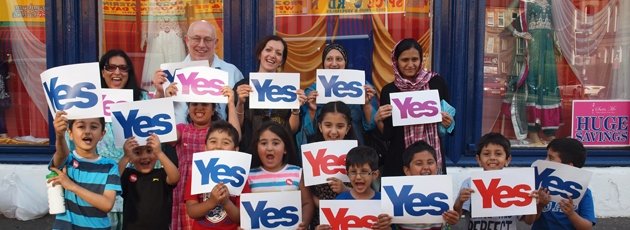
Scotland Decides - BME vote crucial
Unless you’re living in Scotland it doesn’t matter who are you-Black or white, Scottish, or English- you will not have a say in the outcome of Scottish referendum about independence. Interestingly though the tens of thousands of BME(Black and minority ethnic) residents in Scotland, mainly living in Glasgow and Edinburgh could easily be the deciding factor in a debate that will be won or lost on the smallest margins.
Living in London of course means that I cannot vote, but I do feel strongly about whether Scotland should stay or leave.
I want Scotland to stay in the United Kingdom. This is not party politics, OBV would never advocate political parties. Furthermore, this referendum asks the voter to choose simply whether or not you want Scotland to stay in the Union.
But key to my response in this debate stems from my British identity. I suspect like me, most second, third, and forth generation African, Asian, Caribbean people, when asked about national identity refer to ourselves not as English, Scottish, Welsh, or Northern Irish. Interestingly, and this needs better understanding, most of us describe ourselves as being British. However, that may be changing in Scotland.
Of course we have other national, religious and regional identities too, such Muslim, Sikh, Indian, Caribbean, Chinese, Northerner, Londoner, etc. And that’s precisely the point. For many of us born in England, Scotland, Wales, and Northern Ireland, these narrow identities fail to encompass our story, our journey and history of our communities.
I’m English, born and bred here. I support the English football team which by the way is often at least 40% Black, but I just cannot bring myself to say I’m an Englishman. Two elements are at play here - first, the English and Scottish identity rarely includes us. When most of us think of Englishness, we think of cream tea and scones, cricket on the village lawns, London based bankers, football hooligans and warm beer. In most people’s definition of Englishness we don’t exist. Similar comparisons can be made for the other countries which make up the Union.
When we say we're British however, you are instantly reminded of a Diaspora, and a history which demands to be told. Within our British identity we are asserting that we are more than cream tea and scones, bagpipes and kilts.
In that British narrative, we are able to assert a multicultural identity and a back story that says: ‘We’re here because you were there’. You were there in our ancestral lands, enslaving, exploiting, and appropriating all that was ours. But that British story says more than just being oppressed. It also says, in spite of that terrible past, with greater equality, and opportunity and a tacit acknowledgement of who we really are, we are prepared to embrace Britishness.
And so in many ways I want this modern progressive articulation of Britishness to be strengthened. I strongly feel that if the Scots should leave, that strength in unity is undermined,
Interestingly, however, that’s not the whole story. Many more BME individuals living in Scotland are happy to call themselves Scottish and reject the London power domination of the United Kingdom. Some of that comes from many taking an anti-Iraq war stance, another strand comes from buying into the anti-English fervour that some Scots hold.
So this debate is not straight forward by any imagination.
Ultimately though I can’t help but feel that we underestimate what we’ve got until it's being taken away. We should not forget that being Black British, Asian British, Chinese British, or just simply British fantastically unites us as a multicultural people with a shared vision.
In the end those living in Scotland will decide whether to leave or stay with the Union. Whichever way they vote I hope BME communities north of border use their democratic franchise and make their voices heard.
Simon Woolley
This article was commissioned by the Eastern Eye
Warning: INSERT command denied to user 'u568180419_drupaluser'@'localhost' for table `u568180419_drupal`.`watchdog` query: INSERT INTO watchdog (uid, type, message, variables, severity, link, location, referer, hostname, timestamp) VALUES (0, 'php', '%type: %message in %function (line %line of %file).', 'a:5:{s:5:\"%type\";s:6:\"Notice\";s:8:\"%message\";s:36:\"Trying to get property of non-object\";s:9:\"%function\";s:17:\"listingFromMenu()\";s:5:\"%file\";s:89:\"/home/u568180419/domains/obvarchive.com/public_html/sites/default/themes/zen/template.php\";s:5:\"%line\";i:530;}', 3, '', 'https://obvarchive.com/node/7758', '', '216.73.217.7', 1789279789) in /home/u568180419/domains/obvarchive.com/public_html/includes/database.mysql.inc on line 170
Warning: INSERT command denied to user 'u568180419_drupaluser'@'localhost' for table `u568180419_drupal`.`watchdog` query: INSERT INTO watchdog (uid, type, message, variables, severity, link, location, referer, hostname, timestamp) VALUES (0, 'php', '%type: %message in %function (line %line of %file).', 'a:5:{s:5:\"%type\";s:6:\"Notice\";s:8:\"%message\";s:36:\"Trying to get property of non-object\";s:9:\"%function\";s:17:\"listingFromMenu()\";s:5:\"%file\";s:89:\"/home/u568180419/domains/obvarchive.com/public_html/sites/default/themes/zen/template.php\";s:5:\"%line\";i:535;}', 3, '', 'https://obvarchive.com/node/7758', '', '216.73.217.7', 1789279789) in /home/u568180419/domains/obvarchive.com/public_html/includes/database.mysql.inc on line 170
Warning: INSERT command denied to user 'u568180419_drupaluser'@'localhost' for table `u568180419_drupal`.`watchdog` query: INSERT INTO watchdog (uid, type, message, variables, severity, link, location, referer, hostname, timestamp) VALUES (0, 'php', '%type: %message in %function (line %line of %file).', 'a:5:{s:5:\"%type\";s:6:\"Notice\";s:8:\"%message\";s:28:\"Undefined variable: startpos\";s:9:\"%function\";s:17:\"listingFromMenu()\";s:5:\"%file\";s:89:\"/home/u568180419/domains/obvarchive.com/public_html/sites/default/themes/zen/template.php\";s:5:\"%line\";i:570;}', 3, '', 'https://obvarchive.com/node/7758', '', '216.73.217.7', 1789279789) in /home/u568180419/domains/obvarchive.com/public_html/includes/database.mysql.inc on line 170
Warning: INSERT command denied to user 'u568180419_drupaluser'@'localhost' for table `u568180419_drupal`.`watchdog` query: INSERT INTO watchdog (uid, type, message, variables, severity, link, location, referer, hostname, timestamp) VALUES (0, 'php', '%type: %message in %function (line %line of %file).', 'a:5:{s:5:\"%type\";s:6:\"Notice\";s:8:\"%message\";s:20:\"Undefined offset: 1\";s:9:\"%function\";s:27:\"_menu_block_auto_generate()\";s:5:\"%file\";s:108:\"/home/u568180419/domains/obvarchive.com/public_html/sites/all/modules/menu_block_auto/menu_block_auto.module\";s:5:\"%line\";i:14;}', 3, '', 'https://obvarchive.com/node/7758', '', '216.73.217.7', 1789279789) in /home/u568180419/domains/obvarchive.com/public_html/includes/database.mysql.inc on line 170
Warning: INSERT command denied to user 'u568180419_drupaluser'@'localhost' for table `u568180419_drupal`.`watchdog` query: INSERT INTO watchdog (uid, type, message, variables, severity, link, location, referer, hostname, timestamp) VALUES (0, 'php', '%type: %message in %function (line %line of %file).', 'a:5:{s:5:\"%type\";s:6:\"Notice\";s:8:\"%message\";s:18:\"Undefined index: \";s:9:\"%function\";s:27:\"_menu_block_auto_generate()\";s:5:\"%file\";s:108:\"/home/u568180419/domains/obvarchive.com/public_html/sites/all/modules/menu_block_auto/menu_block_auto.module\";s:5:\"%line\";i:23;}', 3, '', 'https://obvarchive.com/node/7758', '', '216.73.217.7', 1789279789) in /home/u568180419/domains/obvarchive.com/public_html/includes/database.mysql.inc on line 170